

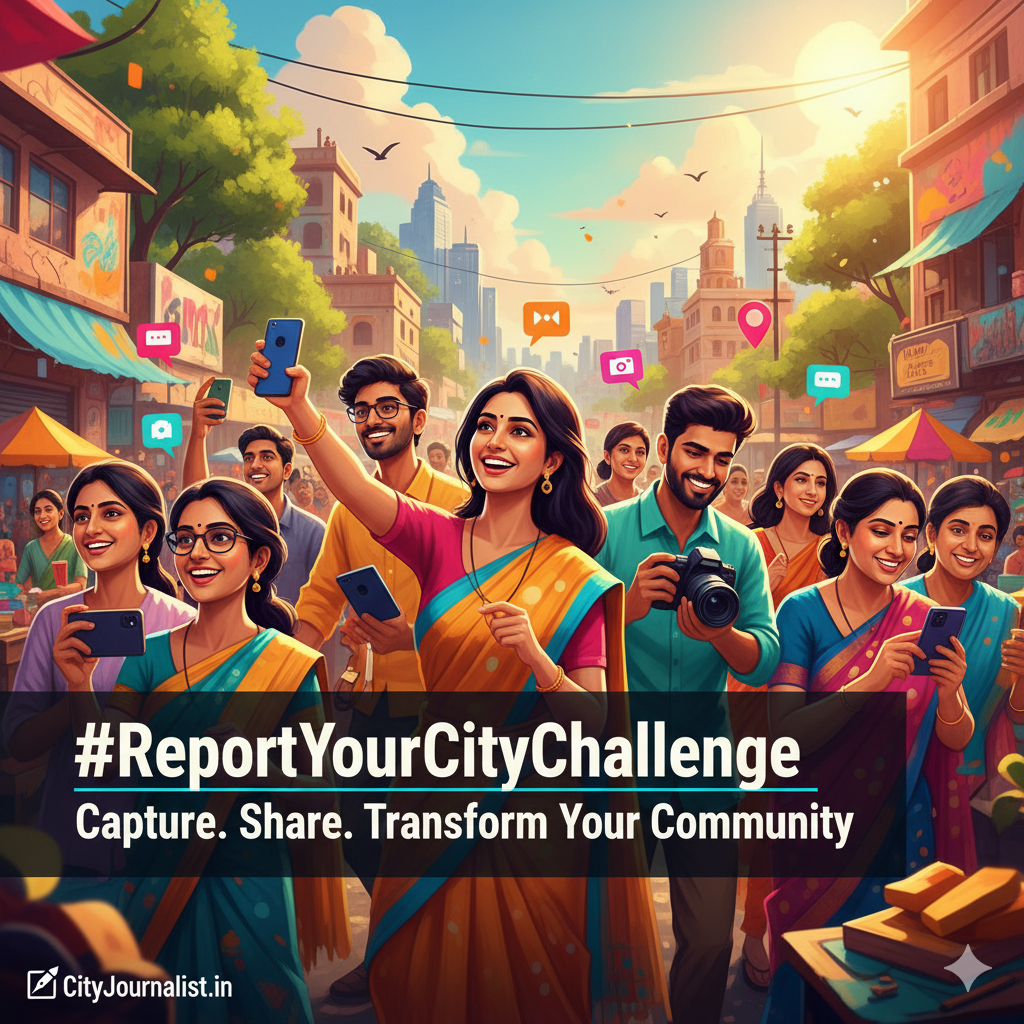
A Deep, Step-by-Step Guide for Beginners
You don’t need a press badge to make a difference. You need a curious mind, a smartphone, and a commitment to truth and service.
Starting as a citizen journalist is less about technology and more about discipline: seeing clearly, checking carefully, and sharing responsibly. This article gives you a practical, step-by-step playbook — from the first observation to publishing, amplifying, and following up — with ethics, safety, and real examples woven in.
Ancient Wisdom to Begin With
The Mundaka Upanishad gives us the timeless line: “Satyameva Jayate” — Truth alone triumphs.
The Bhagavad Gita (3.19) teaches: “Perform your duty without attachment to results.”
These remind us: reporting is a duty — done for the common good, not for personal fame.
Quick Roadmap (What you’ll learn in this guide)
- Preparation: mindset, ethics, and basic tools.
- Before you report: observation, permission, and quick verification.
- While reporting: capturing media, interviews, and safety.
- After reporting: edit, verify facts, write, publish, and follow up.
- Tools, templates, and rules for true citizenship.
- How to measure impact and build your local network.
1) Prepare: Mindset, Ethics & Tools
Mindset & Ethics (non-negotiable)
- Truth first. Prioritize accuracy over speed.
- Serve, don’t sensationalize. Aim to inform and improve, not to inflame.
- Respect dignity. Protect vulnerable people — don’t publish names or faces without consent.
- Act responsibly. If your report could endanger someone, pause and consult.
Scriptural anchor: Bhagavad Gita (2.47) — “You have a right to action, not to its fruits.” Report as duty, not for likes.
Essential tools you already have
- Smartphone with camera (photos + video).
- Voice recorder (built-in app or a simple recorder).
- Notebook (digital or paper) for names, times, places.
- A simple editor (phone apps or free desktop tools) to trim and caption.
- A secure messaging app (for private source communication).
(You’ll learn exact app categories and examples later in Tools section.)
2) Before You Report — Observe, Note, Verify (Pre-report checklist)
Observe like a journalist:
- What happened? (event or condition)
- Where exactly? (street, building name, GPS if safe)
- When? (date & time)
- Who is involved? (names & roles)
- Why does it matter? (impact on people)
- How did it happen? (sequence of events)
Quick verification (do this before you publish)
- Ask: Is this first-hand? If yes, proceed. If not, ask for evidence.
- Check with at least one independent witness (someone else who saw it).
- Take a clear photo/video — with timestamp if possible (phone does this automatically).
- Note the source’s name and contact (with consent).
Consent & privacy
- If reporting about people in private moments or vulnerable situations, ask permission to record/publish.
- If someone refuses, consider anonymizing (blur faces, avoid names).
- Never publish private medical, financial, or sexual details.
3) While Reporting — Capture Media and Collect Facts
How to capture useful media
- Video: 20–60 seconds of context + single-shot close-ups of details. Try to hold phone steady or rest it.
- Photo: Take wide, mid, and close shots. Wide for context; close for detail.
- Audio: Record clear short statements or ambient sound. Use voice notes for quotes.
- Notes: Write exact quotes and spell names correctly.
Interview tips (if you speak to people)
- Introduce yourself and explain why you are recording.
- Ask for permission to record/publish.
- Use open questions: “What happened?” “How did it affect you?”
- Don’t interrupt. Note non-verbal cues (tone, emotion).
Safety while reporting
- Never put yourself in physical danger. If a situation looks risky (crowd violence, unstable building, active protest), observe from a safe distance or call authorities.
- For sensitive issues (sexual assault, abuse), prioritize the survivor’s safety and dignity. Contact local support services rather than publishing identifying details.

4) After Reporting — Edit, Verify, Write, Publish
Verification (second, deeper pass)
- Cross-check facts with a second, independent source.
- For documents/claims, photograph or scan supporting evidence (bills, letters, notices).
- Beware of deepfakes and edited media — if something seems off, seek another confirmation.
Editing & clarity
- Trim long videos to the essential 20–60 seconds with context.
- Crop/blur to protect identities if needed.
- Add captions: who, what, where, when — in 1–2 lines. Use simple language.
Writing the report — a short structure
- Headline (6–12 words): Clear + specific.
- Lede (1–2 sentences): What happened and why it matters.
- Body (5W+H): Who, What, When, Where, Why, How — in that order.
- Quote(s): One or two short human quotes add weight.
- Action/Outcome: What should happen next? Who to contact?
- Attribution: Sources and any disclaimers.
Example short lede:
“Residents of Ram Nagar report raw sewage flowing through Main Street for three weeks. Local families say children have fallen sick; municipal helpline has not responded.”
Publish responsibly
- Publish on your chosen platform (WhatsApp group, blog, Instagram, CityJournalist.in) with clear captions, date/time, and a link to evidence if any.
- Tag relevant authorities or civic handles when appropriate. Be factual, not accusatory.
5) Distribution & Amplification — Get the Right People to See It
- Share in local WhatsApp groups, Facebook neighborhood groups, Nextdoor-style platforms, local NGOs, and community leaders.
- Tag municipal accounts, councillors, and local NGO handles — politely ask for action.
- Use 1–2 relevant hashtags (e.g., #RamNagar #CleanWater).
- Follow up after 24–72 hours with new evidence or updates.
6) Follow-Up & Accountability
- Track responses: Did the civic body reply? Was work done?
- If no action, escalate: collate evidence and approach local media, RTI (if applicable), civil society groups.
- Publish follow-up stories: progress, delays, or solutions found. This shows persistence and builds credibility.
7) Tools, Templates & Quick-Use Assets
Handy tool categories (and examples)
- Photo/video editors: basic cropping & captions.
- Audio recorder & editor: for clear interviews.
- Note apps: time-stamped notes.
- Secure messaging: for sensitive sources.
- Simple graphics maker: for easy infographics or evidence collages.
(You can pick apps that suit your phone/OS — focus on tools that make your work clearer and faster.)
Reporting checklist (copyable)
- Date & time noted
- Exact location noted (landmark/street)
- 1+ clear photo (wide/mid/close)
- 1+ short video (20–60s)
- 2+ corroborating sources (names recorded)
- Permission obtained where needed
- Sensitive info redacted or blurred
- Captions & lede written
- Relevant authorities tagged/contacted
- Follow-up scheduled
Headline formulas (use plain language)
- “Local [problem] leaves [people] at risk”
- “How [person/group] solved [problem] in [place]”
- “[X] days after [problem], authorities respond”
- “Why [issue] matters for [neighborhood]”
Short consent script (verbal)
“Hello, I’m [name], a community reporter. May I record this? I will share the story to ask the council to act. Do you agree to have your name published?”
8) Rules for True Citizenship — Code of Conduct for Every City Journalist
- Truth & Accuracy: Verify before you publish.
- Do No Harm: Protect identities when people are vulnerable.
- Transparency: Declare your role and any bias.
- Attribution: Credit original sources.
- Correct Mistakes: If wrong, correct transparently and quickly.
- Respect Privacy: Don’t share private data or intimate details.
- No Paid Advocacy: Avoid publishing paid promotions disguised as news.
- Non-Violence: Avoid inciting or celebrating violence.
- Community First: Aim for solutions and constructive outcomes.
- Follow Law: Know local defamation, privacy, and safety laws and avoid legal risks.
Vedic reminder: the duty to society (lokasamgraha) is greater than individual gain. Report to serve the good of the many.
9) Legal & Safety Considerations (practical, not legal advice)
- Defamation: Avoid false claims about named persons. Stick to verifiable facts.
- Child protection: Never identify children in abuse cases.
- Sensitive locations: Avoid publishing exact locations of safe houses or sensitive shelters.
- Personal safety: Do not confront dangerous individuals alone; call authorities.
If in doubt about legal risks, consult local legal aid or an NGO before publishing.
10) Measuring Impact & Growing Your Influence
- Track responses (replies from authorities, fixes completed).
- Save proof (before/after photos).
- Build a simple folder of your reports — this becomes your credibility portfolio.
- Network with other city journalists — share tips, amplify each other’s stories.
Real Anecdote (inspiration)
A small neighborhood group in Pune started documenting overflowing drains and posted weekly updates. After persistent reporting and by tagging the municipal office, the drains were cleared and a long-term repair scheduled. The group then trained other neighborhoods to document civic problems — turning reporting into collective action.
Key Points (at a glance)
- Start small: one photo, one short report, one follow-up.
- Verify: two sources or supportive evidence before you publish.
- Protect people: ask consent, blur identities if needed.
- Persist: follow up, measure action, and publish updates.
- Serve: report to help, not to harm.
FAQs
Q1. I’m not a good writer — can I still be a citizen journalist?
👉 Yes. Photos, short videos, and clear captions are powerful. Start small; your skill will grow.
Q2. What if an authority accuses me of spreading false news?
👉 Keep evidence, document your verification steps, and be ready to correct factual errors quickly. If threatened, seek local legal or civic support.
Q3. How do I protect sources who fear retaliation?
👉 Use anonymity: don’t publish names, blur faces, avoid precise locations, and use secure messaging for communication.
Q4. How often should I publish?
👉 Quality over quantity. Publish when you have verified information or a useful update. Regular weekly posts build trust.
Actionable 7-Point Plan — Do this Today (concrete)
- Pick one issue in your neighborhood (e.g., broken streetlight).
- Gather one clear photo and one short video (20–60s).
- Find one corroborator (neighbor or shopkeeper) and note their statement.
- Write a 2-line lede + caption with date, place, and impact.
- Post it in your local community group and tag the municipal helpdesk.
- Save all evidence in a dedicated folder.
- Schedule a 3-day follow-up to report progress or escalate with more evidence.
You’ve just completed your first responsible citizen report.
Call to Action
If you’re ready to turn observation into service, join a growing tribe of local changemakers.
👉 Join the Citizen Tribe at https://CityJournalist.in — share your first report, get templates, and connect with other City Journalists.
Leave a Reply